Wednesday, January 04, 2012

What 'alternative' means now (in music)


I just watched (OK, intermittently fast-forwarded though) '50 Top Alternative Anthems' on MTV Classic (down under). That list, which was topped by Creep, Seven Nation Army, and Love Will Tear Us Apart, also included Gnarls Barkley's Crazy, Outkast's Hey Ya, Oasis's Wonderwall, and The Verve's Bittersweet Symphony. But all of the latter were among the broadest of mainstream hits of their respective years. Each sold massively to everyone from hipsters to Grannies, all over the world, just as they were intended. One possibility is, then, that the always somewhat suspicious 'alternative' label has become completely meaningless and unhelpful.

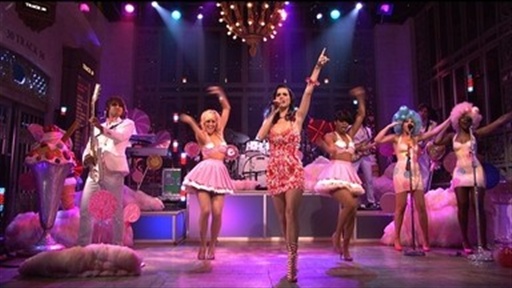
But here's another possibility suggested by listening to the NPR: Planet Money (streamable/downloadable) podcast on Rihanna and contemporary (paradigmatically summer) hit-making. Music that's written, performed, and produced overwhelmingly by the artist/group his/her/itself (or jointly with a single Producer/Engineer team - say roughly along the lines of a George Martin or a Brian Eno or a Nigel Godrich) counts as 'alternative'. It's (broadly) individually expressive compared to the corporate/industrial/Darwinian/networked/distributed (it's not clear which if any of these descriptors is the right one!) model that Rihanna et al. use. The latter is proudly as close as possible to being purely expressive of/written by/a function of the market and the zeitgeist. The purpose of an outsize visual personality/front end (Rihanna, Xtina, Ke$ha, Katy Perry, Kylie, etc...) in this model is to hide/distract from/make bearable the genericness/impersonality of the product. It says something about how popular music has evolved that formerly mainstream, ambitious outfits like Outkast and Gnarls and Oasis are starting to look like crazy DIY romantic freaks. It's the same evolution that's happened in movies: former epitomes of mainstream mass-entertainment direction such as Cameron and Spielberg start to look like wild-eyed romantic individualist auteurs next to the truly cynical, corporate ministrations of Sherlock Holmes Bastardized 2, Pirates 4-Eva, Marvel Comic Extrusion/Reboot/Carbuncle 2, etc.. Hence, Dana Stevens's quip about the contemporary movie situation: "Big, A-list movies that lack 3-D and a toy tie-in are the new scruffy indies".

Sunday, January 01, 2012

Maxine Sullivan's If I Had A Ribbon Bow (1940)


Most of the vids I put up on youtube are genuine videos, but just occasionally, when I notice that one of my very favorite songs or recordings isn't anywhere to be found on youtube, I prefer to whack up the track with just a single image to accompany it. That's the case here. This is the first known recording of the semi-traditional (Huey Prince and Louis Singer are listed as writers) 'If I had a Ribbon Bow'. According to Wikipedia, Maxine Sullivan recorded this in 1936, but it's collected on a Classics 1938-1941 CD, and iTunes/eMusic et al. identify the recording as from August 1, 1940. (My own copy of the track is on a strange, early '90s, 2-disc Sony compilation A Tribute to Black Entertainers.)

Sullivan was from Homestead (just outside Pittsburgh) PA, but hit the (semi-)big time in NYC, singing initially mostly at the Onyx Club w/ her (soon-to-be) husband John Kirby's band, but soon getting a radio show on CBS and performing and appearing in films with Louis Armstrong. Sullivan seems to have taken a decade or more off after her initial success to raise a family but came back in the late '50s, appearing in the famous A Great Day in Harlem photo with everyone.

Sullivan's early recordings had a very pure, cool, unaffected tone that partially anticipated songbook breakthroughs by Ella and others in the late '40s. And Sullivan was strikingly beautiful. In sum, although she's currently well-known only to early jazz-buffs, Sullivan's ripe for rediscovery by a wider audience.

Homestead itself is in the process of recovering its memory of Sullivan. Famous principally for steel, strikes, massacres and the great Negro League Baseball team The Homestead Greys w/ the legendary Josh Gibson ('The Black Babe Ruth? Hell no. Ruth was the white Josh Gibson!' is Homestead and Pittsburgh holy writ), Homestead can surely use Sullivan as an important female grace note to its predominantly ultra-macho history.

At any rate, I'd be amazed if this track doesn't eventually draw some advertizing interest. Can't you just hear it floating around some perfume or other luxe product? Fairport Convention's folky version not so much. Hippies.

Friday, December 30, 2011

My Paprika, My Life


Paprika (2006) is the brilliant final film by anime director Satashi Kon, who died tragically of pancreatic cancer in 2010 at age 46. Bike was Andrew Brough's short-lived, post-Straitjacket Fits group. Its cover of Abba's 'My Love, My Life' was the standout track on the (patchy) 1995, Flying Nun Abba tribute, Abbasalutely. Paprika, Bike's cover, and Abba's original song (a somewhat unheralded album track from Arrival, but see here) all deserve to be more widely known than they are. I intend this vid. to contribute to building the audience for each of them, in part by demonstrating some surprising commonalities.
  • Arrival was basically Abba's Rubber Soul/Revolver, which Bike literalizes.
  • Abba's 30-something concerns about hall-of-mirrors effects in long-term, adult relationships are the principal realistic, domestic counterparts of Paprika's Philip K. Dick-style, divided-self, dream-within-dream-scapes.
I've seen it on your face
Tells me more than any worn-out old phrase
So now we'll go separate ways
Never again we two
Never again, nothing I can do

[Chorus] Like an image passing by, my love, my life
In the mirror of your eyes, my love, my life
I can see it all so clearly
(See it all so clearly)
Answer me sincerely
(Answer me sincerely)
Was it a dream, a lie?
Like reflections of your mind, my love, my life
Are the words you try to find, my love, my life
But I know I don't possess you
So go away, God bless you
You are still my love and my life
Still my one and only

I've watched you look away
Tell me is it really so hard to say?
Oh, this has been my longest day
Sitting here close to you
Knowing that maybe tonight we're through.

[Chorus]

Friday, December 23, 2011

My fave 18 tracks of 2011

Like most people, much of the music that's really grabbed me in 2011 was released long ago, and is just mostly new-to-me. So, old albums by Amy Winehouse, Brothers Johnson, Carla Bley and Paul Haines, Chet Baker, Clifford Brown, Clothilde, Evelyn King, Expressos, Fleetwood Mac, Fox, Harold Grosskopf, Holly and the Italians, Husker Du, Kanye West, King Crimson, Lalo Schifrin, Lou Reed, Moev, The National, The Shangri-Las, Sonic Youth, and 5th Dimension are a lot of what's really moved me this year.

I tend to encounter current releases more at the level of singles and through vids (on tv or on youtube). Here are my 1-18 fave new tracks (Q. Why 18? A1. Fits on a cd. A2. After 18 I found myself repeating artists, which made for a less interesting list.) Some of these records have been played to death at this point, so a high placing here doesn't necessarily capture how I feel about a given song now, rather it registers how the track impacted on me initially. That is, I rate a song highly for list purposes just if it (and/or its vid.) rocked me back on my heels and dominated my mental space for some period. Rihanna's and Lana Del Rey's songs and vids, in particular, just did blow me away for several weeks each, hence they're my songs of the year:

We Found Love Rihanna ft. Calvin Harris
Video Games Lana Del Rey
Somebody That I Used To Know Gotye ft. Kimbra
Queen Of Hearts Fucked Up
Blackout Anna Calvi
Holocene Bon Iver
Rolling In The Deep Adele
Motivation [Lil B] Clams Casino
Everything Goes My Way Metronomy
Keep You Class Actress
Countdown Beyonce
Winter Beats I Break Horses
Novacane Frank Ocean
Crystalline Björk
Dirt Wu Lyf
A Real Hero
College ft. Electric Youth
Need You Now Cut Copy
Gucci Gucci Kreayshawn

Monday, December 19, 2011

You know you have an Alison Brie problem

When you find yourself getting inexplicably angry whenever Community spends much time with anyone other than her character Annie:

I'm starting to think that this response might interfere with Mad Men Season 5 when it screens. Like everyone else, I've loved the Trudy and Pete Campbell 'surprisingly strong marriage' sub-plot on MM, but my now evidently borderline prurient interest in Trudy (Alison Brie) may throw off the equipoise of my interest in the show. I'll be slightly, unconsciously angry at Don and Sally etc...for drawing attention away from Trudy, which is crazy!

At any rate, I hope Brie does some movies soon, and that, in particular, someone writes a great screwball comedy for her. She's incredibly funny and smart as well as being smoking hot in a pretty-gal-next-door way. That's the combination that Lombard/Colbert/Stanwyck/Dunne/Hopkins/Arthur had in Hollywood's golden age. Make it so again Hollywood!

Gaga's Problem Identified


One of the most illuminating pieces about Gaga from her Fame/Fame Monster, 2010 prime was Overkiller Queen by David Schmader. Schmader's best point comes late in the article:
Much is made of Gaga's extensive plundering of Madonna, but not enough is made of the speed and intensity with which this plundering has occurred. It took Madonna six years to get from dance-floor diva to international hit-maker to high-art pop icon; it took Gaga four singles, all culled from her debut album. Much like Bo Diddley sped up the blues to make rock 'n' roll, Stefani Germanotta sped up the pop machine that made Madonna to make Lady Gaga.
In the light of all of the singles from Born This Way, this now seems even more right to me than it did in 2010 only with a darker twist. Yes, Gaga leapt directly from Holiday to Like a Prayer/Vogue/Justify My Love/Deeper and Deeper (take your pick), i.e., to the Madonna of Cultural Studies departments. But that's a problem: while there are obvious high-points from that more conceptual, overexposing 1989-1992 Madonna (esp. the tracks I just mentioned), that's a period in which Madonna's music feels secondary to exhibitionism, cultural provocation and domination for its own sake. During that period Madonna burned through a lot of the good will she'd accumulated from her first three, pretty immaculate albums, and she just plain wore out her welcome with a lot of people. Madonna the self-conscious media artist/student of her own image had its moments, but taken as a whole it was too much, too calculating, and ultimately just tiring and boring (in the special way that only the over-wrought and over-stimulating risks - 'Oh, you again. Always with the wanting of attention. Go away!').

It's mildly heretical to say it, but that middle period Madonna, while superficially triumphant was actually a bit toxic. Madonna had to go away for while after it and come back with a more self-contained, more musical focus. Bedtime Stories, Ray of Light, and Music were the result of that pulling back from excess, and they jointly constitute the second great career peak for M. after her initial not-putting-a-foot-wrong/breakthrough period that continued up through the True Blue album. (I count Confessions on a Dancefloor and its tour as M's much lonelier third career peak - five years later we're still waiting to see whether that's all she wrote for M. at pop's top-table - she'll have lasted longer than anyone else if it is.)

Again, heretical though it is to say it, the 'Madonna Studies' period of M. that Gaga has indeed fast-forwarded to, while impressive in certain ways was also obnoxious and unconvincing, and with the perspective of distance was a kind of creative low for M. (notwithstanding its special resonances with certain sub-cultures).

Gaga is currently only superficially triumphant: all of the Born This Way singles have been tiring and boring, hectoring, un-musical attention events. They may deepen Gaga's connections with certain core fans and true believers, but for a wider public it's a disastrous turn. Madonna had all the cultural political capital gained from her first three albums to spend down, whereas Gaga's obnoxious and exhausting phase has to be 'funded' out of only the handful of broadly appealing singles up to Bad Romance. That's a problem. Schmader (and others) called the phenomenon right back in 2010 but they didn't see the problem that posed for Gaga and for the public alike.

Wednesday, December 07, 2011

When the Sunrise Hits


Murnau's Sunrise (1927) is one of the greatest silent films (e.g., Welles, Wilder, Minnelli, and Gondry have all stolen shots from the sequences I collect in this video). Slowdive's 'When the Sun Hits' is one of the greatest 'shoegaze' tracks. In this vid. I combine them, and, in effect, streamline Sunrise away from its controversial (abortive) murder plot (and the somewhat problematic acting choices encouraged). This is meant as a kind of proof of concept that Sunrise could have worked in a less abstract/philosophical mode. That is, in principle, Murnau could have kept almost all of his film's ultra-spectacular visuals, while using a more modern/looser Stewart/Stanwyck acting style (traces of which are there in the performances in any case), thereby becoming a kind of hypercharged, expessionistic Lubitsch.

Of course, Murnau and Sunrise in particular are great just the way they are: flamboyant, mad, and almost impossible to take completely straight. Let me explain.

The violence in Sunrise's (abortive) murder plot destabilizes the narrative, pitching it into Night of the Hunter/Vertigo/Blue Velvet territory. The Man originally responds to The City Gal's drowning suggestion by attempting to throttle her, and later he reacts to The Obtrusive Man who hits on/harasses The Wife by just-barely-faux knifing him in the face (David Lynch recycles the latter scene as Dorothy Vallens's just-barely knifing Jeffrey in the face). These sorts of scenes (up to and including the Man's second near-strangling of the City Gal at the end of the film) mark The Man as seriously unstable/sociopathic, which in turn makes the wife's forgiveness etc. of him unbelievable and dangerous. If we interpret the whole film as 'what actually happened' then one must fear for the Wife and the Baby's safety long term. The principal way around this problem is to embark on a grand overall re-reading of the film: everything from the Man going to bed thinking about killing his Wife (which is visually signposted by the superimposed waters of the lake) until the final 'Finis' sunrise is the Man's dream-state. That's some elephant to swallow, and I don't think that Murnau compels us to accept such an interpretation. Rather I think that Murnau opens this as one possible interpretation of Sunrise, just as Hitchcock protects the readings that Vertigo's several discontinuities open (most famously the 'Incident at Owl Creek Bridge' interpretation of everything after Vertigo's apparently-impossible-to-be-saved-from opening scene). Our projected, streamlined, more-Lubitschy Sunrise would trade away this sort of haunting, crazy richness for greater naturalism and linear intelligibility.