Showing posts with label 1960s. Show all posts

Thursday, May 07, 2015

A Wild Ending for Mad Men

While some sort of soothing, tieing-bows-on-things, ‘where everyone ends up 5 years or a decade hence’ ending for Mad Men is still most likely, here's my own long-shot ‘wild’ ending for the show.
Consider a frame-grab of a guy whose face we never see from the remarkable coda/final scene of Les Bonnes Femmes (1960):

Look familiar? Well, here’s MM’s creator Matt Weiner discussing LBF for a recent museum exhibit and retrospective on MM:
I first saw this in film school and shared it to help the production design of the pilot because it was shot in the streets of Paris, with little embellishment, at exactly the time we were trying to recreate. The thematic aspects were valuable as well, as the film tells the everyday story of four bored working women led astray by their romantic fantasies. My favorite sequence, a kind of postscript to the whole film, is particularly relevant to the series as it features an unknown woman looking right down the lens at the audience.
My first side-bet, then, is that Weiner is going to steal this final shot from LBF for MM's own final shot.
My second side-bet is that Weiner steals much more extensively from LBF’s ending – or more precisely its double-ending – because it’s one of the greatest endings in movie history, yet very few people know it, so it really is super-stealable! Without spoiling anything much, in LBF’s first ending something very nasty and shocking (but also inevitable in retrospect) happens to a beloved figure. Then we get a second ending: a very oblique, dream-like, ultimately fourth-wall-breaking scene with a man whose face we never see and a woman who stares straight at us who’s completely new but also unnervingly similar to - clearly the same type as - the victim in the first ending.

So, here’s my ultra-fanciful long-shot prediction for the end of MM’s finale. A super-shocking first ending for Joan or Sally or Peggy followed by an oblique coda that begins by drifting through a club alighting on a guy in Don’s couch pose whose face we never see as per my first image above, and that ends with that guy dancing with a new woman (presumably another in Don’s line/type of dark-haired, troubled beauties, but maybe waitress Diana) who stares straight at us (my second image above).

It’s unlikely that Weiner will do anything this radical. After all, just the first ‘shocking’ ending would probably cause outrage among most fans of the show (and, with Betty falling to lung cancer this week, would undoubtedly cause some online communities to cry misogynist foul). Does Weiner have the stomach for that?

And what of a very artsy second ending? People semi-rioted when Chabrol dropped this whole package on them in Paris in 1960. Would Weiner go that far out? He's not David Lynch! And yet Weiner has cited Blue Velvet as an important influence, and there have been a few horror notes sounded but not paid off in recent eps, and the whole second half season was dedicated to Mike Nichols, whose period appropriate Carnal Knowledge (1971) has a brutal ending. So a shocking and generally 'far out' ending wouldn't be completely out of the blue if it happened

My 'long-shot' ending for MM is precisely that - highly unlikely – and, looking around online, I seem to be the only one thinking along its lines. Still, Mad Men began by being cinematically true to its original film era of North By Northwest and The Apartment, so if Mad Men were to be true to the film era it’s ended up in – the era of Frenzy, Straw Dogs, Deliverance, Clockwork Orange, Cries and Whispers, Ulzana’s Raid, Get Carter and so on - it should end with a bang. Be Brave Mr Weiner!

Update May 20, 2015: Well, Weiner went for a very safe, fan-servicing ending - no time jumps or narrative surprises of any kind (not even a shift to make Peggy or Joan or Sally at least partially the final perspective of the show; no it's Don all the way). Too bad in my view. Too bad also that the ep. 'Person to Person' committed so thoroughly to its titular phone call backbone. Phone calls, like computer screens, are anti-cinematic and anti-climactic, and having an episode infested with and officially thematized by them doesn't change that.
  • Don's three calls
  • Peggy's phone-call rom-com ending (frittering away the goodwill from the previous week's 'Just stay on the phone')
  • Joan getting to (i) call Peggy, (ii) break up with her Prince while on the phone (to someone else), and (iii) be on the phone for her final shot. 
That's not good TV/Film, let alone good climactic TV/Film.

Wednesday, February 06, 2013

A Chronological Edit of Two For The Road (1967)

Stanley Donen's (dir.) and Frederic Raphael's (wr.) Two For The Road (1967), the grand-daddy of Eternal Sunshine, Memento, and Eyes Wide Shut, is a marvel of time-shifting and match-cutting. My video edits the film chronologically. The edit loses a lot from Donen's ingenious original, but it may be useful to scholars and critics, and in my experience does help certain points and patterns emerge more clearly (much as seeing Memento reordered chronologically does).

My edit 'follows the visuals' and does not attempt to correct any trailing or overlapping audio as we engineer our cut. This is the complete film but it's not polished up the way an actually released 'A Chronological TFTR'; would be (which Donen has always insisted would be deadly dull). That is, this is a 'dvd extra'/scholars' aid not a film in its own right (again along the lines of Memento's dvd bonus of chronological play). While we wait for TFTR to appear on blu-ray, perhaps my video will inspire the inclusion of such an extra on that projected disc.

The only exceptions to my 'follow the visuals' policy occur near the end of the film - a couple of quick flashbacks during David's and Joanna's final conversation are left in that conversational sequence, and the Pirandellesque sequence of shots (including the famous, Simpsons-approved(!) roundabout shot) that immediately precedes Joanna's and Mark's hopeful/resigned border-crossing denouement in the white Mercedes are also left in sequence.

Sunday, December 16, 2012

Advertising Psycho in 1961 in New Zealand

The first advertisement for Alfred Hitchcock's Psycho in NZ's paper of record, The New Zealand Herald was a long column on May 25 1961:

Psycho had opened in the US a full year before, in June 1960, so presumably the NZ movie-going public was absolutely ravenous to finally see the new sensation, and possibly ticked off at having had to wait so long. The second Herald notice (May 28, 1961) appears to acknowledge that situation:

although the rumors referred to may also be to censorship possibilities/worries (NZ's censors followed the UK's in imposing cuts on Psycho's shower sequence).

The third Psycho ad. repeats the savagely chopped and inserted title/logo, but also dramatically announces and imprecates!

The fourth ad., now directly underneath the ad. for the current occupant (The Sundowners w/ Kerr and Mitchum) of the St James cinema announces that tomorrow there'll be a big announcement:

The (possibly anti-climactic) announcement turns out to be that bookings will now be taken:

On June 7, 2 days before Psycho opens, Hitchcock the showman returns:
Psycho does different things to different people! And no one but no one will be admitted after the film begins.

The same day, the evening paper in Auckland, The Star announced the winners of its various Psycho-related competitions including its Hitchcock-look-alike:

Come on down Mr H. Pietry to the most terrifying, shocking, and generally incredible film experience of your life!

One day to go and the Herald can barely control itself:

Thursday evening's Star and Friday morning's Herald indirectly hail the grand opening:

Friday night's Star, however, takes the biscuit:

It's now Psycho time and DO NOT KILL YOUR FRIENDS' (enjoyment by telling them the ending). Note the specification in the ad. of exactly when the main feature will start, i.e., after roughly 40-50 minutes of shorts (including travelogues features such as 'Ports of Paradise' and short documentaries from Rank films' Look at Life series. Water shortages in England before Psycho - who woulda thunk it?!)

As in North America, Psycho played in NZ with no previews so both the Herald and the Star reviewed Psycho on Saturday June 10. Both reviewers act very wise about Hitch's marketing savvy. Neither mentions Herrmann.

After Psycho is released the ads become a parade of Alfred Hitchcock Presents drollerie sometimes with two Hitchcock representations to drive the point home:

Even William Castle would be proud of "Pay no attention to the rumour that this film may send you completely berserk!' or "If you can't keep a secret keep away from people after seeing Psycho". Most tho' not all (e.g., not the rumor of speechless wives) of this schtick was drawn from an acclaimed media/marketing package of teaser ads prepared by Paramount:
.

A couple of post-release ads are worthy of special note.

I thought that use of supposed infra-red footage of audience reactions in advertizing began with '70s mega-thillers such as The Exorcist and Jaws, but here it is as part of Psycho's ad. frenzy. Was Psycho then the first with this?
And, finally, a reference to shows packing out:

Psycho was a well-deserved, monster hit world-wide, the showbizerry of which left an imprint on a whole generation.

Tuesday, October 23, 2012

Hitchcock in How To Steal A Million (1966)

More images here. Audrey reads the August 1965 issue of Hitchcock Magazine: La revue du suspense, a battered copy of which was recently for sale on ebay:

Monday, August 20, 2012

Two Recent Vids

"Turn Your Back On The Wind"/"Believe In Love" (1970) was one of The Fourmyula's final, unsuccessful singles, but it has since achieved renown on their various Best Of/Compilation releases. It hasn't been available on youtube up till now except in a recent live version here. I hereby plug that gap:

My visuals are the heartbreaking last few minutes of King Vidor's Stella Dallas (1937) w/ Barbara Stanwyck in the title role. The story is as follows: Stella wants what's best for her daughter, Laurel (Anne Shirley), and she realizes that Laurel will only be able to 'marry up' if she exits from her daughter's life (Stella's hard-scrabble roots constantly show through, vulgarities cause embarrassment, etc.). Laurel, however, won't abandon her mother just to better herself. So Stella has to fool Laurel that she, Stella wants her daughter out of the way so that she can herself pursue another husband. In the final scene Stella watches her daughter's wedding from out in the street in the rain, happy that her ruse has secured her daughter's future and probable happiness. It's a 'two boxer', and a triumph for both Vidor and Stanwyck. The obvious strong case for Stanwyck as one of the 2 or 3 greatest screen actresses starts here perhaps.

Soon after the release of Bob Fosse's film Sweet Charity (1969) (which adapted Fellini's Nights of Cabiria, via the original stage-show that Fosse also directed and choreographed), Paul Mauriat rearranged and reorchestrated part of Cy Coleman's Overture into this magnificent pop-classical/lounge band confection. This piece of music was used as background music, e.g., for events montages, throughout the 1970s.

Fosse's film starred the great Shirley MacLaine as Charity Valentine. The film's a bit of a dud overall. but MacLaine is dynamite, as is much of the music and dancing. Many of the stills I've used come from a very warm appreciation of the film due to Ken Anderson here.

If you want to see what a more successful, ultra-dramatic version of the underlying story looks like, watch the ending of Nights of Cabiria here. In my perfect Hollywood-world, MacLaine would have got to star in a straight remake of Nights of Cabiria as well as Fosse's musical. Oh well.

Note that Mauriat's Sweet Charity first appeared on his album Un Jour, Un Enfant (1969):

Sunday, July 29, 2012

Pete Campbell: Standby

After the Spector-produced and Weil and Mann-written You've Lost That Loving Feeling, and after producing the Weil and Mann-written (You're my) Soul and Inspiration, Stand By was Bill Medley's attempt to do the whole thing himself: write, produce, sing (w/o any help from Hetfield). It's the same (force 9 gale, melodramatic) song and performance again, only this third time through impassioned, abject masculinity, the leavee's lament is from an even more pathetic perspective: not a current-leavee but a past-leavee who's stuck in the past ('I'm not her man, I'm just her standby/...So I'll pretend her love is mine'. Interestingly Medley swallows many of the 'her's so that, in particular the key line ends up mostly sounding like, 'I'm not a man, I'm just her standby' which is more self-lacerating and somewhat less pitiful.

The song's pathetic perspective reminded me of Mad Men's Pete Campbell (brilliantly played by Vincent Kartheiser) esp. in the wonderful Season 5 episode, Signal 30, written by the late, great Frank Pierson and splendidly directed by John Slattery. In the ep. Pete flirts with a high school senior (Amanda Bauer) in Drivers' Ed. and gets punched out by Lane. Signal 30 is set in 1966, the year when the album Stand By appeared on was released.

Friday, July 20, 2012

Crud in the Shower Scene (on Psycho's 1999 dvd edn)

Dirt, hairs, and the like (click to make bigger):

Presumably later editions including the recent Blu-ray will have tidied up these sorts of imperfections/artifacts.

Thursday, June 07, 2012

The Women of 'The Other Woman', Mad Men S05E11

Mad Men's pivotal, Season 5 Episode 11 ended with a terrific musical flourish: The Kinks' immortal 'You Really Got Me' from 1964, which cuts off over the credits. It seemed like a good idea to put together a montage starting with the song's entry point in the episode but then continuing on for the whole song.

Friday, May 18, 2012

Abba's Frida (age 21) sings Ein ledig tag

The song is 'Ein ledig tag' ('A day off', 'A free day'). The setting is 26 September 1967, on a popular Swedish TV show, Hylands Hörna (although some versions of the videotape are date-stamped September 3).

It's a near virtuosic song, but Frida's pitch is perfect, and her expressive choices are beautiful. She's already a consummate professional, handling awkward questions at the beginning straightforwardly, firmly but lightly.

The segment reminds us of just how talented and, in Frida's case, feted the Abba boys and girls were as individuals. It's easy to imagine Frida fans from the '60s (and her teachers perhaps) originally tut-tutting that with Abba she was squandering her talent on pop music for kids, and that she was 'slumming it' by signing up with Benny and Bjorn in the 1970s.

Bonus Awesomeness: Frida sings a reworked Swedish version of 'Alice Blue Gown' in 1970. That vid. vaguely reminds one of Cremaster 1.

Wouldn't Frida have made a great Queen of Chain for Cremaster 5 had Ursula Andress not done it?!

Friday, March 16, 2012

Sunday, February 26, 2012

To The End In Marienbad


Blur's remarkable song 'To The End' had a stunning video, directed by David Mould, which drew extensively on Alain Resais's notorious puzzle-piece film, Last Year in Marienbad (1960). This video returns the favor, reverse engineering Mould's video using actual Marienbad footage (where I select the closest counterpart shot from the film for each music video shot; I 'cheat' once, to cover a Mould innovation, but you'll have to know the film very well to spot it!).

Mould's video featured Blur's Damon Albarn and Graham Coxon in their pomp, and a marvellously expressive, gamine, balletic model, Amanda Doyle (who's often been misidentified as Stereolabs's Laetitia Sadier, who did To The End's French backing voice) as the 'mystery woman' in an uncertain love triangle.

Doyle, Albarn, and Coxon make an incredibly pretty trio (one that's significantly more youthful and charming than Resnais's), and in Mould's hands a warm, romantic, relatively conventionally arc-ed (cynics might say, 'Tatler-ific') confection emerges, one that's interestingly orthogonal to Resnais's glacially paced and legendarily chilly 'classic'. While its influence on things like The Shining is clear, Marienbad is now mostly ignored and forgotten, and mocked to the extent that it's not. (At least in the English-speaking world, Marienbad may currently be less famous than and certainly is less loved than Pauline Kael's dismissal of it as a "high-fashion experimental film, the snow job in the ice palace" and as the butt of her "People are hosting 'Come as the Sick Soul of Europe' parties" joke.) And that's to say that Marienbad is for the most part a 'classic' in a Twainian sense: it's a film that many more people want to have seen than who actually want to see it.

Blur's video in 1994 changed the equation for Marienbad, at least to some degree (not least because it reminded people that Marienbad would have been a lot easier to take without its unpleasant, mostly organ score: if, say, Herrmann, or Badalamenti, or, yes, even Blur had scored, things could have been very different for the film over time). In my view the song's one of the core triumphs of Britpop (and one of the 'best songs of the '90s period), and the vid. is a marvel of the smartypants/art-school (say, Velvets/Bowie-ish) side of pop music more generally. If you've ever liked that side of pop then moments like U2 getting to make films with Wim Wenders, and Blur having their way with an icon of the Nouvelle Vague are just jam. They are as much part of the core appeal and fascination of pop/rock stardom as anything else is, at least for that audience.

I hope that this vid. stimulates discussion about actual and possible relations between pop culture and high art culture. And the vid. should build the audience for both Resnais and Blur: film snobs (you know who you are) should listen to Blur if they haven't already, and Blur-fans now have even more of a pathway into one of the most arduous of art-films.

Monday, August 08, 2011

The Shangri-Las II


A simple vid I made for a remix of one of their 'Shadow' Morton penned/produced classics from the Stonewall (1996) soundtrack. The mix is nothing special really, but the Shangs. haven't been remixed much, so it struck me as worthwhile getting up on youtube.

Sunday, August 07, 2011

The Shangri-Las


Like a lot of people, I've been re-listening to Amy Winehouse over the past week or so, and really appreciating her pop sensibility. That's led me to explore some of Winehouse's pop/girl-group influences a little more thoroughly than before, esp. the Shangri-Las. The Shangs' best records are simply incredible: great songs including a bunch written by Brill Building, presiding geniuses Ellie Greenwich and Jeff Barry, fabulously atmospheric conceptual productions, and great vocal/dramatic performances by Mary Weiss. A heck of lot of stuff that we all love from the last 40 years of music from the Velvets and Lou Reed to the Who to Gainsbourg to Abba to the Ramones to Blondie to Kate Bush to Propaganda to (I'd argue) MBV to Winehouse to Bat for Lashes is deeply indebted to the Shangs' colloquial melodramatics. And just look at them in early 1965:

And listen to where they got to by 1966:

and where they began in 1964:

They had 'it' from the beginning, and never lost 'it'. Just, wow. The Shangs haven't so far been inducted into the Rock and Roll Hall of Fame (Greenwich and Barry are in, as are The Ronettes and Darlene Love). That should change. Lesley Gore and the Crystals deserve to be inducted too, but the Shangs are a bigger omission in my view. The conceptualness and cinematicness that the Shangs introduced to pop means that the history of pop and rock simply doesn't decode properly without them. Their omission may be part of what Frida from Abba had in mind when (at Abba's own induction) she pointedly, smartly drew attention to how few female artists had made it in to the Hall:

p.s. If you need convincing that Ellie Greenwich's genius extended beyond her monumental '60s tunes, consider the following:
EG: Yep. And years later, I was working with Cyndi Lauper on her single "Girls Just Wanna Have Fun". And during the rehearsals, they got kind of... stuck on the breakdown part of the song. So I thought for a minute, and then it came to me: "Girls. They want. Wanna Have Fun. Girls. They wanna have. Just wanna, they just wanna. Girls. Girls just wanna have fu-un." And so that's what we went with.
That, of course, is the bit of the song that pushed it over the top into joyousness/greatness, making it an instant classic/standard.

Friday, April 08, 2011

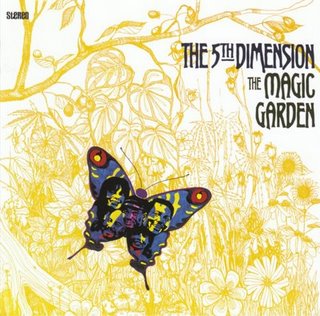
The 5th Dimension's The Magic Garden


A seriously amazing record from December 1967, The Magic Garden is a concept piece about love and a specific love affair in something like the way Demy's films from the period tend to be.

Every song is excellent, but my two current fave tracks are:

and:

I mean, good God, they kill. The album is definitely some kind of masterpiece. I almost can't believe I never heard of any of it until this Onion AV-Club article.

Ok, one more (this time w/ uncool dancing):
Just, wow.

Update April 11, 2011: All but one song on TMG is written by the legendary Jimmy Webb. The exception is a very soulful, funky cover of Ticket to Ride. This song (from Help!, e.g., here) is one of Lennon's best. It's the ancestor of all of the mildly perverse, bitchy ‘I’m not happy but I’m not sad either’ alt-pop-music (with, ha ha, triumphant pulsing music underneath) that so many of us have loved ever since. TtR claims the whole spectrum of vexation and boredom and general pissiness for pop music, and makes it danceable and almost metallic. A couple of days a week I’d say it was the best, most subversive pop hit since Heartbreak Hotel.

Anyhow, 5th Dimension's TtR cover is exemplary. In my view, too, Lennon's ode to nasty ambivalence (with its booty-shaking underpinning pushed to 11!) fits beautifully within TMG's overall song cycle (about a tumultuous relationship), albeit as a spectacular jolt of earthy energy. Some fans have wanted TtR pushed to the TMG's margins, and apparently some editions of the album, which has even had its name changed a couple of times, have accommodated that desire. I think it works great as a side-ender/mid-point:

An odd feature of 5th Dimension's TtR cover, however, is that they change Lennon's middle eight couplet from:

She oughta think twice/She oughta do right by me.
to:
She oughta think white/She oughta do right by me.
The punchier, full rhyme of white/right sings better than twice/right, but it's still a surprising change, after all, if full rhyme singability was the principal concern, why not go with repetition, right/right? 'White' was evidently, quite specifically chosen, but with what purpose?

On the one hand, the Fifth Dimension were unfairly/absurdly criticized at the time for being 'too white', just as many Motown acts were (see this article for some of the details; it's evident that the nasty criticism is a class thing more than a race thing, but it's still painful). On the other hand, their TtR cover (on which the players were members of the racially mixed Wrecking Crew) is the 'blackest' thing on TMG by far (insofar as we can make sense of such ideas). Presumably the rhyme substitution is making some real point or specific inside joke. But what exactly? Does anyone have the political nous about the 1967 West Coast scene to really decode this matter?