Friday, December 14, 2012

Getting in touch with your inner Scorpio

Via Google Earth:

And via youtube:

One of the best opening scenes of all time with one of the best scores.

Wednesday, December 05, 2012

Cinefantastique's review of The Empire Strikes Back

The Empire Strikes Back was not as fondly welcomed at the time as is often recalled these days. A lot of people initially held the inconsistency of both 'the twist' and Emperor with the original Star Wars against the film - were quite grumpy about it - and had to gradually talk themselves into going with the flow. Of course, everyone loved Yoda and the Imperial Walker attack on the Rebels and the Cloud City's design from the get-go, so there were plenty of good starting points from which affection for Empire could and did grow.
The leading sci-fi film magazine of the time, Cinefantastique roasted the film in its review. Here's that notorious review from the Hitchcock's The Birds issue both in original images (click on images to make big, then save the images so that you can zoom in on them as required):

and as text:

THE EMPIRE STRIKES BACK 

"A lifeless copy of STAR WARS propelled chiefly on the momentum of that earlier film."

THE EMPIRE STRIKES BACK 20th Century Fox. 5/80. 124 minutes. In 70mm Scope. Dolby Stereo. Executive Producer, George Lucas. Directed by Irvin Kershner. Produced by Gary Kurtz. Screenplay by Leigh Brackett and Lawrence Kasdan. Story by George Lucas. Production designer, Norman Reynolds. Director of photography. Peter Suschitzsky B.S.C. Edited by Paul Hirsch. Special visual effects, Brian Johnson, Richard Edlund. Associate producers. Robert Watts, James Bloom. Music by John Williams. Design consultant and conceptual artist, Ralph McQuarrie. Art directors, Leslie Dilley. Harry Lang, Alan Tompkins. Makeup and special creature design, Stuart Freeborn.
Luke Skywalker Mark Hamill
Han Solo Harrison Ford
Princess Leia Carrie Fisher
Lando Calrissian Billy Dee Williams
See Threepio (C-3PO) Anthony Daniels
Yoda Frank Oz
Darth Vader David Prowse
Chewbacca Peter Mayhew
Artoo Detoo (R2-D2) Kenny Baker
Ben (Obi-wan) Kenobi Alec Guinness

It's hard to argue with success. In a summer of boxoffice doldrums that is seeing many potential hits playing to near empty auditoriums, this film is packing full houses. If the downturn in film business is indeed being caused by the current recession as many suspect, then audiences are getting by with less somewhere just to go out and enjoy THE EMPIRE STRIKES BACK. In the hardest of times people can eat less, stay at home, and wear their clothes longer, but they can't survive without a dream.
Considering the impact THE EMPIRE STRIKES BACK is having, it's probably irrelevant whether it's a good film or not. With some form of merchandising, tie-in or promotion connected with the picture striking you in the face at every turn, it's difficult to perceive the movie as anything more than a two hour commercial specifically designed to sell more model kits, action figures and comic books. Before I could reach my seat, ushers had twice thrust a copy of the "official collector's edition" program book in my face, hawking it like carnival barkers. I later examined a copy and found that some 37 pages—more than half its contents —consisted of a plot synopsis, a real handy thing to have. (Incidentally, the book is published under exclusive license from Shorebrook S.A., a Swiss company, which probably indicates George Lucas is trying to shelter some of his STAR WARS lucre in a tax haven.)
But despite its pervasive impact and obvious success, THE EMPIRE STRIKES BACK is a lifeless copy of STAR WARS propelled chiefly on the momentum of that earlier film. Without the likes of a Peter Cushing or Alec Guiness to add some dignity and solid support, Mark Hamill, Carrie Fisher and Harrison Ford flounder in roles that are certain to doom their careers regardless of the series' success. Critics who labeled this film "better than STAR WARS," must have been watching the audience instead of the performance.
What's at fault is an atrocious script which marks time for most of its length, then winds up unresolved, leaving the audience dangling on a plot contrivance. I fail to see the contribution of a fine screenwriter. not to mention fine science fiction writer, like Leigh Brackett in any of it. I assume the comedy patter which passes for dialogue was the work of co-credited Lawrence Kasdan. What, after all, could Brackett, or director Irvin Kershner for that matter, do with a non-story like that supplied by Lucas? When it turns out that Han Solo has flown his ship inside a slow moving space slug, and we see it narrowly escape from the jaws of what looks like a kid's hand puppet, this is surely the most ludicrous science fiction seen since the days of live television in the '50s!
In this film its often impossible to figure out whether audience laughter is unintentional or not. And it doesn't seem to matter. Whether laughing at it or with it, people are having a good time. The fun, the generally high production values, some remarkably convincing and imaginative special effects, and most of all that momentum from STAR WARS, manage to carry the script's dead weight.
The use of stop-motion animation is a tremendous plus and provides the film its single most outstanding sequence, when Imperial walkers attack the rebel base on Hoth. The animated Tauntauns also delight and amaze audiences and further demonstrate that dimensional animation is indispensable in putting across this kind of screen fantasy. Use of the technique in THE EMPIRE STRIKES BACK with such outstanding results is going to prove to be a boon to the field. Surely Hollywood, if not Dino De Laurentiis, will now sit up and take notice!
Other effects are equally eye-opening. Frank Oz uses puppetry to bring Yoda to life to a degree I would not have thought possible, an achievement that bodes well for The Muppets' own fantasy themed feature THE DARK CRYSTAL. And even though it's an old cliche when Han Solo runs into the ever present asteroid field. the wonders of motion control photography can visualize the dizzying excitement as it's never been done before.
But, as in any performance, the play's the thing. And in that department THE EMPIRE STRIKES BACK is not nearly so wondrous. It's at its apex when the opening reprise of John Williams' STAR WARS theme blares out over the loudspeakers, and from there it simply runs down like a big wind-up toy, in fits and starts, until it jerks to a halt. The bad pacing is the direct result of a script which at its core has no story to tell. At fault is the basic premise George Lucas devised for the sequel, to do it like a twenty-minute serial chapter ten times over. It that's his idea of an "epic" - I suggest that after all nine chapters are filmed he sit down with his wife Marcia at the editing bench and do one of those 90-minute condensations for those of us who don't want to be bored silly. An hour and a half should be more than adequate to contain his epic story once he cuts out all the pointless running around.
Although we're continually being told by studio p.r. that Lucas has a grand design for the series, I get the distinct impression that he's bluffing his way through, making it up as he goes along. The result is that what little story development we get in THE EMPIRE STRIKES BACK often seems at odds with what we know from the first film.
It's a fact that Lucas decided at the last minute, during filming, to kill off Ben Kenobi in STAR WARS. Maybe this was before he had his plan jotted down? In any case, it's a decision that's literally come back to haunt us, as Kenobi now pops up in the sequel at the oddest times like some spectral Greek chorus, dropping pearls of wisdom or just providing a little stage direction ("Go to Dagobah."). Somehow I found his disembodied voice in STAR WARS less troublesome. Now that I can see as well as hear him, the question of what actually happened on the Death Star, when Ben miraculously dematerialized out of his clothes, is starting to nag. Apparently he went back and picked up his duds because he's wearing them again. And you'd think Luke would do some head scratching about it too, after all, he thought Ben was dead. Now he has regular conversations with him.
I'm troubled too by the type of Emperor Lucas introduces in the sequel. I distinctly remember Governor Tarkin telling Darth in STAR WARS, "The Jedi are extinct. Their fire has gone out of the universe. You, my friend, are all that's left of their religion." So naturally, I was a bit surprised in the sequel to see the Emperor phone up Darth long distance and complain about a disturbance in the Force: If any more practitioners of this extinct religion turn up they're going to have enough to form a congregation.
The Force itself isn't quite so interesting either, now that Lucas has begun to elaborate on exactly what it is. It was a simple but intriguing idea in STAR WARS, "an energy field created by all living things that surrounds us, penetrates us, and binds the galaxy together," according to Ben. In THE EMPIRE STRIKES BACK it somewhat disappointingly turns out to be just your basic telekinesis. In a conclusion best described as CARRIE meets STAR WARS, the script has Darth Vader mentally hurl all the loose furniture at Luke in order to defeat him. This is a good example of the tendency Lucas has of lifting ideas, often inappropriately. from other sources.
The big puzzle is the film's "big revelation", when Darth Vader tries to work up some family feeling with Luke after cutting off his hand! Bad timing to pick that particular moment to confess his little indiscretion with Luke's mother and call the boy "son"- But then Darth has always shown very little tact in dealing with people.
Actually though, the script made him do it. You just need to have some kind of big pay-off for these penultimate light-sabre duels. Unfortunately, George Lucas doesn't have the heart to kill off any of his characters, so he's been forced to come up with some pretty convoluted resolutions. I suggest he just suspend dueling, before it gets too confusing. After all, the duel in STAR WARS turned Obi-wan into a ghost, and now the duel in this one turns Luke into a bastard. This latest development is getting a bit chancy on a PG-rating.
Actually though, there's probably another explanation. Could it be that Darth Vader and Mr. Skywalker are one and the same person? I suppose this is what Luke himself has in mind when he shouts his reply to Vader's revelation its the film: "That's impossible!" Sure as hell seems to be, judging from what we've seen in STAR WARS. Ben tells Luke in that film, "A young Jedi named Darth Wader, who was a pupil of mine until he turned to evil, helped the Empire hunt down and destroy the Jedi Knights. He betrayed and murdered your father." It's the scene, you'll recall. when Ben gives Luke his father's light sabre.
So, if you ask me, Luke's got to be a bastard—Vader's illegitimate son, perhaps as a result of rape? That would certainly be in character for Darth and would add a new dimension to the catch phrase "seduced by the dark side of the Force." I guess we'll just have to wait for Lucas to consult his master plan and have old Ben Kenobi's ghost explain it all in the next film. Somehow, I get the feeling watching THE EMPIRE STRIKES BACK, that it's not going to be a very convincing explanation.
Frederick S. Clarke (Cinefantastique 10(2), Fall 1980: 40-41)


Friday, November 30, 2012

iTunes 11 f---ing sucks

Too exasperated to even anatomize here, but let's just say that directly adding a new item to, say, the n-th place in a playlist on your ipod is now impossible. That's a deal-breaker for me.

More generally, at every turn, any attempt to get a clear picture of all of your media at once (even on your main computer, let alone on that and (in a separate window) any other device you may have) is frustrated. Even the ability to navigate between songs at the level of their information has been removed (so, e.g., if you want to enter the track number and name info for an album you have to exit from the informational summary for one file, go back to song listing then choose the informational summary for the next file, and so on: what was formerly a one click operation now takes a 4 or 5 steps. Entering the info for a whole album that used to take 10 clicks, now takes 40 or 50.)

In sum, a program that has up till now been unwieldy and irritating, has with version 11 finally become unusable and non-functional. Sell Apple now. The company has completely lost its mind.

Update: Having slept on it... things aren't quite as bad as I thought. For example, the multi-information I mentioned seems to have more contextual than I realized - you can't manoeuvre at that level in some playlist views and in artist view, but otherwise it seems OK (maybe the database has caught up with the problem overnight - it definitely seemed to be a more prevalent problem yesterday). So... grumble grumble OK. But another big problem: I've found that the search doesn't work as it should. I have songs by Annie Lennox both on her own albums and on compilations like Red, Hot and Blue, yet searching on 'Lennox' or 'Annie Lennox' no longer brings up the latter. Staggeringly, I can get the latter to come up when I home-share my collection and search using the older itunes on the other device. So in the strongest possible way iTunes 11 has gone backwards. That's unacceptable, dismal, etc.. Yes iTunes probably is improved in various ways but, like a car with all sorts of arguably interesting new features that nonetheless runs off the road or can't take a corner, it's still a piece of shit.

Update: To get iTunes search to behave reasonably, go to the search box and uncheck 'Search Entire library' and go with just 'Filter by All' checked. With that and the sidebar permanently turned on things feel almost back to functional (except for the no multiple windows problem which inflicts inefficiency across the board, presumably on the theory that inflicting what's optimal for ipads/iphones etc. on every other environment is acceptable now).
Tuesday, November 27, 2012

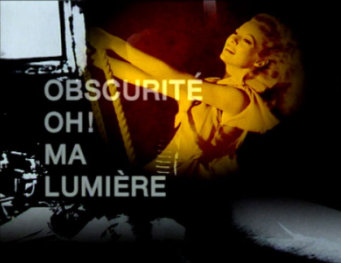
Godard's Histoire(s) du cinéma

Gap-filling on Sight and Sound's new Hot 100, I'm checking out Godard's Histoire(s) (1988-1998), which some have praised, see, e.g., here and here (for a vital aid). In his New Biographical Dictionary of Film Thomson lauds as follows:

Of course, it was natural that Godard would provide his own retrospective—and sweep up the entire medium. Histoire(s) du Cinéma is a great catalogue work, worthy of Robert Musil or Walter Benjamin—or Chris Marker. But in its astonishing beauties, and the suggestiveness of its editing, one may still see and feel the Godard of the early sixties. Thus, the Histoire(s) reasserted, beyond doubt, that his is one of the great critical yet poetic minds in the medium.
Unfortunately, so far (just one headache-causing hour in) I feel like Thomson's more caustic remarks about Godard's 1950s criticism apply equally well to Histoire(s):
"[T]ruly useful insights were offered in writing that was appalling, trite, chaotic, and gratuitously unreadable. It came armed with frightful name-dropping from literature and painting. Hardly a film could be classified without reference to Faulkner, Proust, Auguste Renoir, or Velázquez. In part, this was his need for classification, the unappeasable urge to cross-refer rather than to describe a thing itself. And these references are meaningless....Godard’s criticism is so aggressive that one feels only its insecurity... It means that his articles are addressed to himself, rather than to readers. The tone is austere and forbidding, as if to exclude others from cinema in the very act of celebrating it."
Godard actually says relatively little in his own voice, and there it's mostly sententious nostrums to which one mostly wants to shrug or perhaps laugh (much as you would to a standard, empty political speech). But occasionally he makes a factual claim, some of which are plainly wrong, e.g., at 19 mins into the first part of the doc., Godard claims that Howard Hughes was a producer (producteur) of Citizen Kane, which is false. (Compare: a fluffy, largely content-free political speech that nonetheless makes a few it's easily-checked claims about unemployment rates or Benghazi or whatever.... that turn out to be flatly false.) The impact is devastating... it becomes very hard to stick-with Godard, to take him seriously. Overt contradictions such as between 'Cinema is not part of the communications industry or entertainment. It is part of cosmetics, the industry of masks.' (2nd part, 7 mins in) and 'It [cinema] boils down to entertainment. It can't be explained otherwise.' (2 minutes later) don't help either.

Since Godard doesn't care enough to get basic stuff right it's hard to have faith in or even ascribe determinate content to his more oracular, necessarily uncheckable remarks. Whether Histoires(s) can be satisfactory conceived as its own self-contained mega-video-art-piece/work of political science fiction remains to be seen, but on current evidence (update: 2 hours in) it can't be. Rather it appears to just be a mess, stuck in some messy zone between The Power of Nightmares, Sans Soleil, Cremaster Cycle, and Inland Empire, and decidedly inferior to all of those boundary points.

So who got Godard's Histoire(s) onto the Sight and Sound list (and ahead of, I dunno, Rear Window, M, NbNW, Touch of Evil, Night of the Hunter, and Sunset Boulevard)? Jonathan Rosenbaum, Richard Corliss, and who else?

Update: Finished it! Good God, well that's 4+ hours I'm never etc.. One of the (in my view, relatively few) highlights is his tribute to Hitchcock in the penultimate Chapter 4a (Le Contrôle de l’univers (1998) - The Control of the Universe). Godard's characteristically hyperbolic remarks (whch work much better accompanied by counterpointing, often slow-mo Hitchcock clips) are as follows:

We forget why Joan Fontaine leans over the cliff.
Why was Joel McCrea in Holland?
What confession did Montgomery Clift keep secret?
Why did Janet Leigh stop at the Motel?
Why does Theresa Wright still love Uncle Charlie?
What isn't Henry Fonda entirely guilty of?
Why did the American government hire Ingrid Bergman?

But we remember a handbag.
But we remember a bus in the desert.
But we remember a glass of milk, a windmill, a hairbrush.
But we remember a row of bottles, a pair of glasses, a musical score, a key chain.

Because with them and through them Alfred Hitchcock succeeded
where Alexander, Caesar, Hitler and Napoleon failed:
In taking control of the universe.

Maybe 10,000 people haven't forgot Cèzanne's apple
but a billion remember the lighter in Strangers on a Train.

Hitchcock, the only accursed poet to meet with success.
Our century's greatest creator of forms.
Forms tell us what is at the bottom of things.

What is art, if not the way forms become style?
What is style... What is style, if not man?

So it is a bra-less blonde tailed by a detective scared of heights
who proves that it's all cinema, that is, child's play.

Wednesday, November 21, 2012

The White Shadow (1924)

Great intertitles:

Here Nancy, the girl without a soul, sang and danced and gambled.

Bohemians live and die – but the Cat still laughs!

Friday, November 09, 2012

American Democracy in Action

Pennylvania’s awful gerrymandering of congressional districts (since the post 2010 census redistricting) has ensured that it grossly over-represents Republicans and under-represents Democrats at the Federal level. So this year (2012) Repubs won 13/18 PA congressional districts = 72% of the available representation despite winning only 49% of the vote! (See all data here - you have to add things up yourself at this point):

Total/popular votes for Dem House candidates in PA = 2,702,901
Total/popular votes for Rep House candidates in PA = 2,627,031

PA is truly a travesty of democracy with a downright evil Republican establishment (much anti-Clinton nonsense during the '90s sprang from Western PA) that should shame any principled conservative.

Sadly it’s the same story nationally (modulo recounts and provisionals still to be counted), although corresponding Democratic hackery elsewhere evens things up considerably:

total/popular votes for Democrat House candidates ~ 54 million
total/popular votes for Republicans House candidates ~ 53.5 million

Less than 50% vote share gets the Repubs at least 233 reps, i.e., at least 53% of the House.

The US has much to be proud of politically speaking, but also much that's patently disastrous, completely avoidable, and finally just shameful.

Friday, November 02, 2012

God's on Twitter

And evidently knows his away around 140 chars:

Personally speaking, it's conceivable that Obama's going to win re-election and that he wouldn't have without Superstorm Sandy throwing various bad-for-Mitt issues into newly sharp relief. If that's Divine Intervention, while one can question the Big Guy's methods, I guess I'm for it.